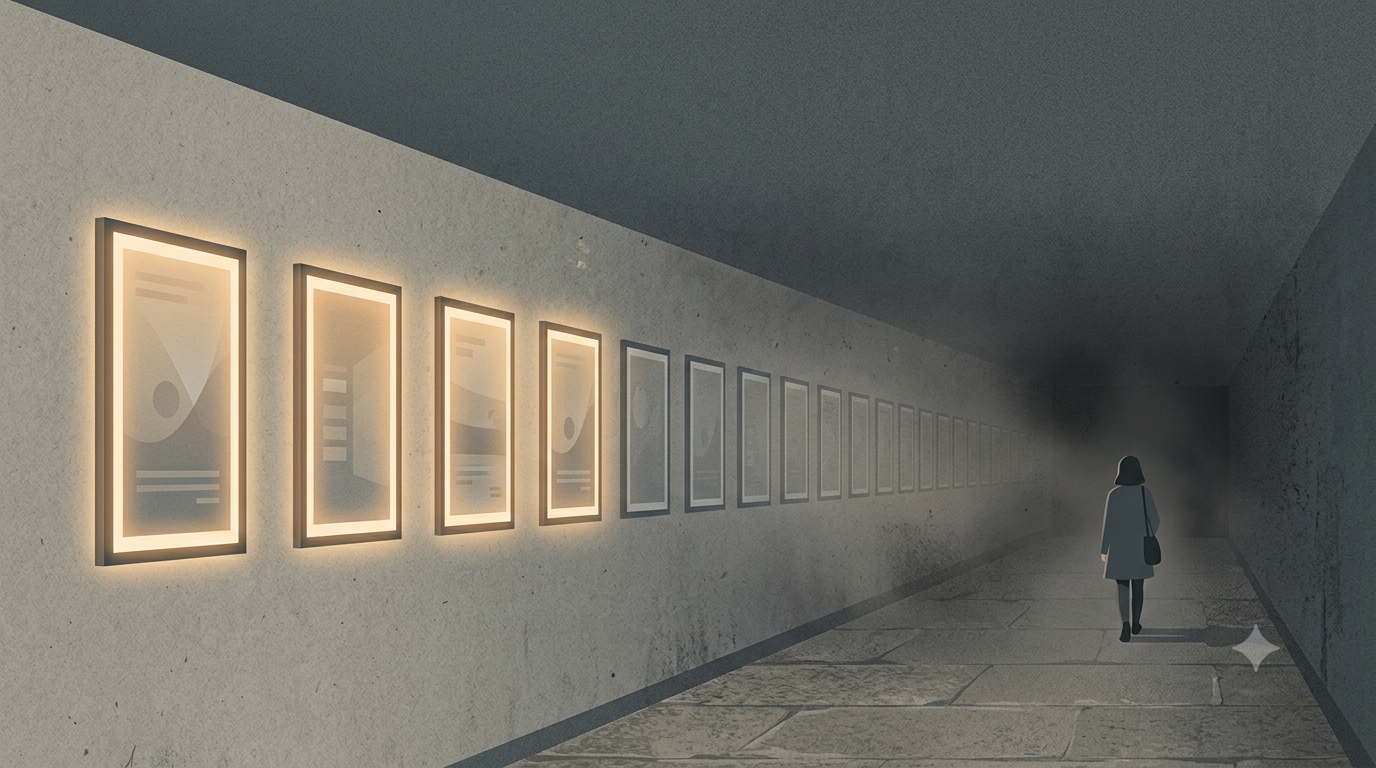
The first few months are always the most exciting.
In 2008 — maybe ‘09, the years blur — I was posting a photograph almost every day. Two platforms, religiously: Flickr and JPG Magazine. JPG was the more interesting of the two. The quality of content was just better. People dumped photos onto Flickr; they put their best foot forward on JPG.
So I posted. Daily. For a couple of months I was fanatic about it. Then, gradually, I wasn’t. I stopped paying attention. Stopped being interested. Stopped using it entirely. Nobody made me quit. The excitement just ran out of fuel.
The platforms didn’t fare much better than my enthusiasm did. Everyone was flocking out, and so did I. One obituary made an observation that has aged remarkably well: the site had become redundant, because thanks to Instagram and a zillion other photo-sharing venues, the whole web already felt like an online magazine of user-created imagery.
The novelty wasn’t a moat. It never is.
Fifteen years later, same movie, new cast
Cut to 2024–25. Everyone had an AI persona. Everyone. People were animating their still photos, shaving twenty years off their faces, rendering themselves as intergalactic saints and anime protagonists. Lensa’s “Magic Avatars” kicked this off, and the numbers tell the whole story better than I can: the app recorded over 19.3 million downloads in December 2022 — then dropped to 1.4 million by January 2023. One month. That’s not a decline; that’s a cliff.
Then came the Ghibli wave. When OpenAI shipped image generation in GPT-4o, a Seattle engineer turned a family photo into a Studio Ghibli-style frame, the trend went viral, and the platform gained a million new users within an hour. Sam Altman said the company’s GPUs were “melting” and imposed rate limits. And then, like every trend before it, the feeds moved on.
None of this should surprise anyone who has shipped a consumer product. The average app loses 77% of its daily active users within the first three days after install. Within 30 days, 90% are gone. Within 90 days, over 95%. That curve was measured on mobile apps a decade ago, but it’s not really a statement about apps. It’s a statement about us. We are novelty-seeking animals with utility-shaped lives. We eat every day because we’re hungry every day. We don’t need a magic avatar every day.
The test I now apply to any product, including my own: is this something people need daily, or something people needed to feel once? My daily photo habit in 2008 felt like the former. It was the latter. I wasn’t building a photography practice; I was consuming the feeling of being published.
The empowerment moment
Which brings me to where generative AI sits right now — and why I think it’s in the exact same spot on the curve.
The dominant sentiment I hear from non-designers today is empowerment. They can make their own flyers. Their own pitch decks. Their own brand assets. They don’t need to hire a professional anymore, and they will tell you this, unprompted, with real joy. Canva spotted this appetite a decade before the LLM era — its CEO framed the AI suite as “built for the 99% of the world without complex design training” — and generative AI has poured jet fuel on it.
Let me be honest about the pros, because there are real ones:
- Access. Individuals and small businesses can now compete in spaces once dominated by organizations with bigger budgets. A street-food vendor making her own menu board in an evening is not a tragedy. It’s a win.
- Speed. The gap between “I have an idea” and “I have an artifact” has collapsed. For low-stakes, disposable communication, that’s genuinely valuable.
- Literacy. More people making visual things means more people who eventually notice what makes visual things good. Some fraction of today’s Canva-and-prompt crowd will become tomorrow’s clients who actually understand what they’re buying.
And the cons, from someone who’s been in the room for fifteen years of these conversations:
- The output floor rose; the ceiling didn’t move. These tools generate the median. The most-cited limitation is homogenized design — everything starts looking like everything else, because it’s all sampled from the same statistical middle. When every flyer looks competent, competence stops differentiating anyone.
- Empowerment is being confused with judgment. The tool gives you execution. It does not give you the ability to know why this layout fails, who this is actually for, or what not to make at all. Most of my career value has never been in the artifact. It’s in the decisions upstream of the artifact — the ones clients don’t see and therefore don’t think they’re paying for. That judgment is the designer’s real zone of genius.
- The churn will come for this feeling too. The person delighted by their self-made deck in month one will, by month six, either graduate into caring about quality (and hire help) or stop caring entirely (and ship mediocrity forever). What they won’t do is stay excited. Nobody stays excited. I have the abandoned Flickr account to prove it.
Where this lands us
Here’s my actual prediction, and it’s less apocalyptic than either camp wants: the demand for routine, low-stakes design execution will genuinely shrink, because clients with smaller budgets will opt for DIY solutions — while the work that requires creativity, critical thinking, and an understanding of human context concentrates further into fewer, more senior hands.
The middle gets hollowed out. The designer whose entire value was “I know the software” is in real trouble — the same way stock photographers were when everyone got a decent camera phone, and the same way I was briefly made “irrelevant” once before. The designer whose value is taste, strategy, and knowing which problem to solve was never selling software operation in the first place.
And the empowered customer? Most of them are three days into a 77%-churn curve and don’t know it yet. Some will keep going and become genuinely capable — good for them, and good for us, because they’ll be the best clients we’ve ever had. The rest will do exactly what I did with those two photo sites in 2009: stop paying attention, stop being interested, and quietly move on — leaving behind a lot of same-looking flyers, and a renewed understanding of why the thing they were briefly imitating was a profession.
The novelty always dies. The utility is what’s left standing. Fifteen years in, I’ve learned to only bet on the second one — which is really the same argument I made about chasing “made better with AI ✨” labels.