AI didn’t make you faster. It made everyone in your team (including you) slower.
I’ve said this in the past and I’m not even the first one to say it — the CEO of Shopify beat me to it, which is funny for reasons I’ll get to.
The man who mandated it is now complaining about it
Back in April 2025, Tobi Lütke sent a memo to everyone at Shopify. Before you ask for more headcount, he said, you have to demonstrate why you cannot get what you want done using AI. Using AI was now “a fundamental expectation.” It would show up in your performance review. Stagnation is slow-motion failure, if you’re not climbing you’re sliding, the whole thing.
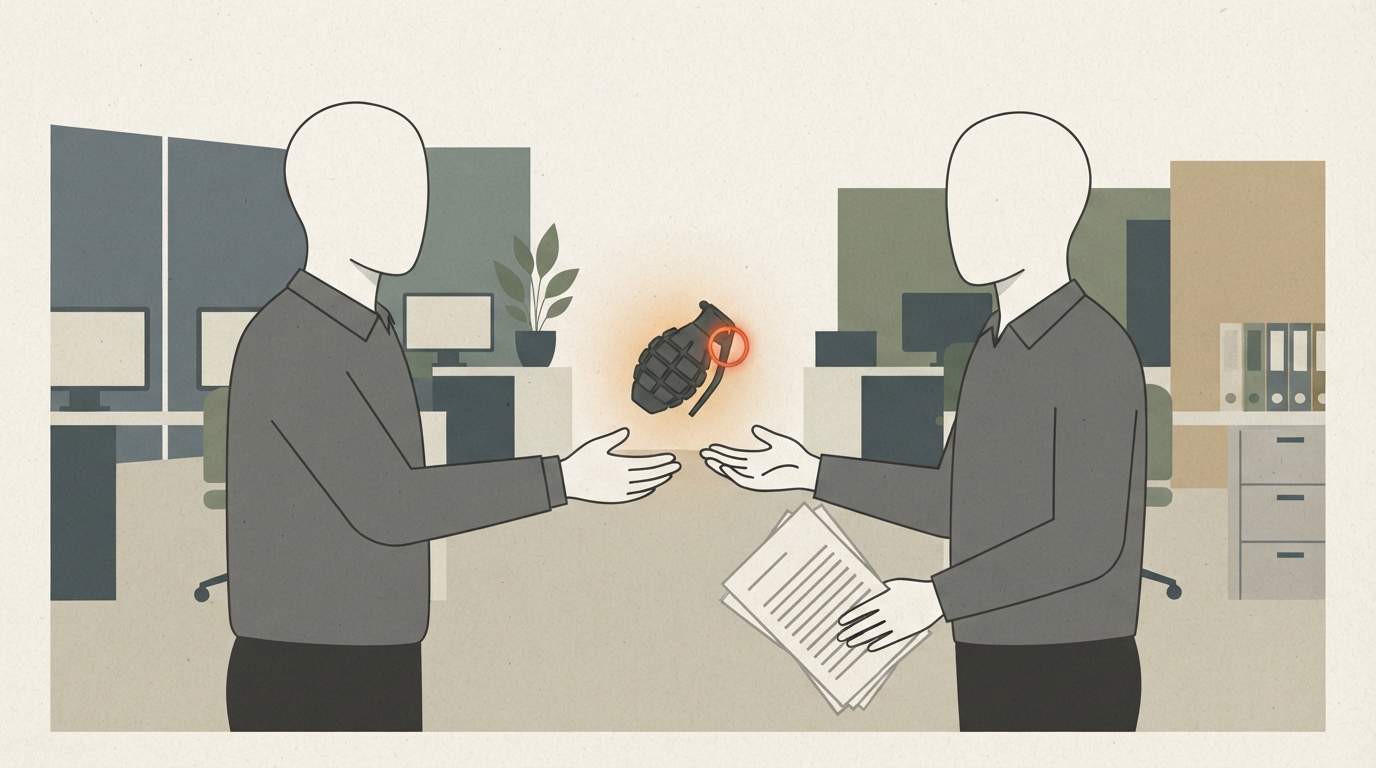
Seventeen months later, on a podcast last week, the same guy described what he got for it. Employees generating AI content, not reading it, and forwarding it to each other anyway.
”We call those ‘slop grenades’ that people toss at each other.”
He also said the quiet part: “The failure case now of lazy work is not lack of output.”
Read that twice. Lazy work used to look like an empty doc. Now it looks like a full one.
He’s not alone in the walk-back, either. Duolingo’s CEO went all-in on “AI-first” and then admitted to Fast Company that he’d got carried away because AI demos beautifully in writing and then falls apart at scale.
So first things first.
What a slop grenade actually is
A slop grenade is work that looks finished. It has headings. It has the right sections. The formatting is clean, the tone is confident, the bullet points are parallel. And it is completely hollow, because nobody thought about the problem before generating it.
The person who sent it didn’t read it. They generated it, skimmed it, saw that it looked like the thing, and pressed send. The thinking they skipped didn’t disappear — it just became your job. You’re now doing their thinking and the archaeology of figuring out what they meant.
That’s the grenade part. It’s not that the work is bad. Bad work has always existed. It’s that the effort has been moved onto you without anyone announcing it.
I get these constantly. Scope docs. PRDs. Sometimes layouts. Every section filled in, every box ticked, and it doesn’t solve the problem — because solving the problem was never the step that happened. The sender genuinely believes they’ve tackled it. They have a document. Documents mean tackled.
I looked up whether anyone had measured this, because I assumed I was just being a grump. Turns out researchers at Stanford and BetterUp gave it a name — workslop — and put a number on it. People receiving this stuff are losing around three and a half hours a month cleaning it up, and that number went up from the previous year.
The part that actually stopped me was the relationship data. People who receive slop rate the sender as less competent. Over a third said they’d avoid working with that person again. One of the researchers, Jeff Hancock at Stanford, explained the mechanism: producing sloppy work used to require effort, and now that the effort is gone, useless content is free to make.
Free to make. Still expensive to read.
So it’s not a productivity tax. It’s a reputation transfer. You’re spending down your colleagues’ trust in you to save yourself twenty minutes.
The app that works and solves nothing
Here’s where this shows up in our world.
Vibe coding is genuinely good now. Someone with no engineering background can describe an app and get a working app. Clean UI, decent spacing, responsive, the CRUD works. It’s real software.
And a huge number of them solve the wrong problem.
Take something boring, like a task tracker. Somebody vibe codes one. It works — you can add a task, assign it, mark it done, filter the table. Looks great in a demo.
Now ask who’s actually looking at it.
A manager opening that tracker wants to know: how many tasks are done versus pending, who’s drowning, what’s overdue, are we going to make it. That’s an oversight view. An assignee opening the same tracker wants to know: what’s mine, what’s due before Friday, what’s blocking me. They do not care about anyone else’s tasks. At all.
Those are two different products wearing the same skin. And what you get from vibe coding is one table with filters, because a filter is a technically correct answer to “different people need different things.” All the data is there! Go find it yourself!
Nobody had to sit down and ask who is looking at this screen and what are they trying to decide. That question is the job. The code was never the hard part.
There’s a designer who described exactly this — AI generated him a permissions dashboard that looked ready to present, except it let admins edit permissions one at a time, and his product uses role-based permissions because per-permission editing is a nightmare to manage. His line stuck with me: these designs answer the prompt well while missing everything around it.
That’s the whole failure mode in one sentence. It answers the prompt. The prompt was never the problem.
And if you want the version of this with real engineering consequences — Google’s own DORA research found that for every 25% bump in AI adoption, delivery throughput and stability both went down, because you generate more and bigger changes than your review process can absorb. Same mechanism. More output, less thinking, and the bill arrives later.
The content is always fake and you can always tell
When I’m mocking up a UI, I need content. Real-feeling content, specific to the persona, consistent across every screen so the thing tells one story. So I ask AI for it. And what comes back is this:
“Finalize Q3 budget review with stakeholders by EOD Friday.”
Nobody. Has ever. Typed that. Into a task tracker.
Real task titles are garbage. They’re fragments. “fix the thing.” “ask sujata re: invoice.” “PDF????” Half of them are shorthand only that team understands. One person has forty tiny tasks and another has three enormous vague ones that have been open since March.
AI gives you the tidy version. Every persona gets a nicely varied, evenly distributed, grammatically complete task list. No overdue junk nobody closed, no duplicates, no task that’s just a question mark. It’s too clean, and clean is the tell.
And this matters more than it sounds, because fake content invalidates your review. People start critiquing the spacing instead of the message. Your text-overflow case never appears because AI never wrote a 14-word headline. Then real content lands and the layout falls over.
The old rule about lorem ipsum still applies — it’s dangerous the moment a team treats it like real text, because a design full of placeholder isn’t done and isn’t ready for review. AI just made the placeholder look real enough that people forget it’s placeholder.
The fix isn’t “don’t use AI for this.” It’s that you have to feed it the constraints first — your actual team’s vocabulary, your actual sprint rhythm, the actual mess. Ask for “sample tasks for a job tracker” and you get a brochure. Give it real scaffolding and it’ll give you something usable. Specificity in, specificity out.
The one that actually makes me angry
Someone uploads the design — a PDF, a JPG, a screenshot — into ChatGPT, asks for feedback, and pastes the output back. Under their name. As their review.
I’ve written about this before and I’ll write about it again, because it’s the worst version of all of this. Reviewing is the job. That’s the whole role. It’s not a deliverable you can generate, it’s the application of judgment you’ve built over years to a decision someone else made.
And AI has none of the context. It doesn’t know why that button is where it is. It doesn’t know we tried the other pattern in March and users hated it. It doesn’t know about the constraint from the backend team, or the business reason, or the accessibility call we made on purpose. So it pattern-matches against generic best practice and flags every deliberate decision as a deviation.
UXmatters put this well: the problem isn’t speed or automation, it’s the quiet erosion of judgment and taste — these tools present outputs as if the uncertainty has already been resolved. It hasn’t. It’s just been hidden.
Then it comes back with fifteen points, and four of them are things any informed human would have discarded on sight. Not because they’re wrong in general — because they’re wrong here, for reasons the reviewer knows and the model doesn’t.
But nobody discarded them. The whole thing got copy-pasted.
And now my team is sitting there going, wait, when did we discuss this? We didn’t. Nobody discussed it. A model generated it and a human lent it their name.
The reviewer’s judgment gets replaced by a tool’s judgment, while still being presented as theirs.
That’s not a quality problem. That’s a trust problem. Same as the slop grenade, actually — someone outsourced the thinking part and passed the output along as though they’d done it. I have previously written about this. Read it here
It’s not just us, which is the depressing part
I went looking to see whether this was a design-people whinge or a real thing, and it’s everywhere.
The maintainer of curl — one of the most-used pieces of software on earth, run by volunteers — shut down their bug bounty programme this January because they were drowning in AI-generated vulnerability reports. Confirmed vulnerabilities dropped from over 15% to under 5%. Seven volunteers, spending up to three hours per report, on reports that identified nothing. He’d said earlier, pretty memorably, that they were effectively being DDoSed.
Lawyers are getting sanctioned for filing briefs with cases that don’t exist. There’s a researcher running a public database of these court decisions and it’s in the four figures now. One attorney got indefinitely suspended after a brief where fifty-seven of sixty-three citations were defective.
And academic publishing. At NeurIPS — one of the biggest AI conferences on earth — over a hundred fabricated citations made it into accepted papers, each of which had gone through three or more reviewers. Peer review. The one process whose entire existence is “a qualified human read this carefully.”
Even the productivity story isn’t safe. A controlled study by METR took experienced open-source developers and measured them with and without AI tools. They were 19% slower with AI. They believed they’d been 20% faster.
Read that one twice too. Not “AI didn’t help.” They couldn’t tell.
Different industries, one mechanism. Producing plausible output got free, so the work moved to whoever has to check it.
Final notes
I don’t mean all “AI is bad, stop using it.” I use it every day. It’s in my mockup workflow, it’s in how I think through problems, I used it to research half the things in this post. That’s not the argument.
The argument is that AI got very good at output and is still bad at judgment, and those are not the same thing. Output is the artifact. Judgment is knowing whether the artifact is right, whether it’s the right artifact at all, and whether you’d defend it to someone who pushed back.
You can’t generate judgment. You can only skip it.
So the rule I’ve landed on is embarrassingly simple, and I stole most of it from the curl guy: don’t send anything you can’t defend without the model in the room. Not “don’t use AI.” Use it. Just read the thing. If someone replies asking why paragraph four says what it says, you should have an answer that isn’t “well, that’s what it gave me.”
If you can’t explain it without the model, it isn’t ready to send. It’s a grenade with the pin out, and there’s a person on the other end.
Be kind to your reviewers. They can tell.